

It’s no secret that pregnancy comes with its own unique set of aches and pains. But while you’ve probably heard of things like round ligament pain, tailbone pain in pregnancy doesn’t get as much attention. Still, it can and does happen. “The tailbone pain was the absolute worst!” shares The Bump community member pinkcallalily. It took time, but she finally felt relief around six weeks postpartum.
If you’re pregnant with tailbone pain, you’re far from alone. It’ll time but it will get better. In the meantime, read on to learn from experts what exactly causes tailbone pain in pregnancy and what might help ease it a bit.
Key Takeaways
- Tailbone or coccyx pain is common in pregnancy, but remains infrequently discussed. It feels like an ache or pain in your bottom, as the tailbone is located at the very base of the spine.
- Tailbone pain can start at any point during pregnancy, but is most common later in the second and third trimesters.
- It’s caused by added stress and pressure on your axial skeleton and pelvis, due to a growing baby, your expanding uterus and the placenta. It can also be exacerbated by the hormone relaxin, which loosens ligaments.
- You can use heating pads, ice packs, yoga and stretching to improve this pain in pregnancy and postpartum. However, if it doesn’t go away you may need to seek a pelvic floor physical therapist.
- If left untreated, coccyx pain can get in the way of daily activities, like walking and sitting, as well as affect your pain level during future pregnancies.
What Is Tailbone Pain During Pregnancy?
The tailbone (also known as the coccyx) is the small bone located at the very base of the spine. This is where tailbone pain, aka coccydynia, is typically felt. “I’ve heard some of my patients say it’s a pain in their bottom—literally,” says Christine Greves, MD, an ob-gyn at the Winnie Palmer Hospital for Women & Babies in Orlando, Florida. And while it’s not often the chief complaint among pregnant women, it’s common enough. “More than half of pregnant women experience back pain. A smaller amount experience tailbone pain,” notes Greves. Michael Cackovic, MD, an ob-gyn at the Ohio State University Wexner Medical Center, says that he “probably hears about from patients two to three times a day.”
What Causes Tailbone Pain During Pregnancy?
The cause of tailbone pain in pregnancy can vary. When you’re expecting, there’s a lot of stress on your axial skeleton (the bones that make up your head, neck and trunk) and your pelvis, and that can lead to pain and joint issues, says Jessica Shepherd, MD, a Texas-based ob-gyn.
There’s also direct pressure on your tailbone from your growing baby. “The tailbone, or coccyx, is immediately behind and below the uterus,” Cackovic says. “In a normal term pregnancy, that means there’s about 10 to 12 pounds pushing on it when you account for baby, placenta, uterus and fluids.” Plus, “your tailbone serves as a point of attachment for many tendons and ligaments, all which have nerves that’ll fire when something presses on them,” he adds. Even seemingly minor things like constipation can make it worse.
One more thing that could be worsening your coccydynia in pregnancy: Relaxin, a hormone secreted by the placenta. “Relaxin’s role is to relax the ligaments in the pelvis to allow for birth, and it can make the tailbone more sensitive,” Cackovic says.
Maybe I’m the last person to know that having a big baby can seriously mess with your tailbone…After an office visit and some x-rays, we found that my tailbone was likely dislocated initially, but is now just sort of out of alignment. I’ve got a physical therapy evaluation tomorrow to help fix the damage done to my back from sitting in strange positions and will be going to the spine institute to have a steroid/anti-inflammatory injection in my tailbone area to hopefully reduce the swelling and pain while it continues healing. And I’ve got some nice muscle relaxers to help me while my back heals. Sure would have been nice if someone had ever told me that this could happen but I’m glad I’m getting it taken care of now.
When Does Tailbone Pain Start in Pregnancy?
While coccyx pain usually happens more in the later stages of pregnancy, it can start during any trimester, Cackovic says. It’s dependent on factors like your body size, pelvis type and whether you’ve been pregnant before. Still, he adds, “it’s usually worse in the third trimester when the size of the baby and position add the most pressure.”
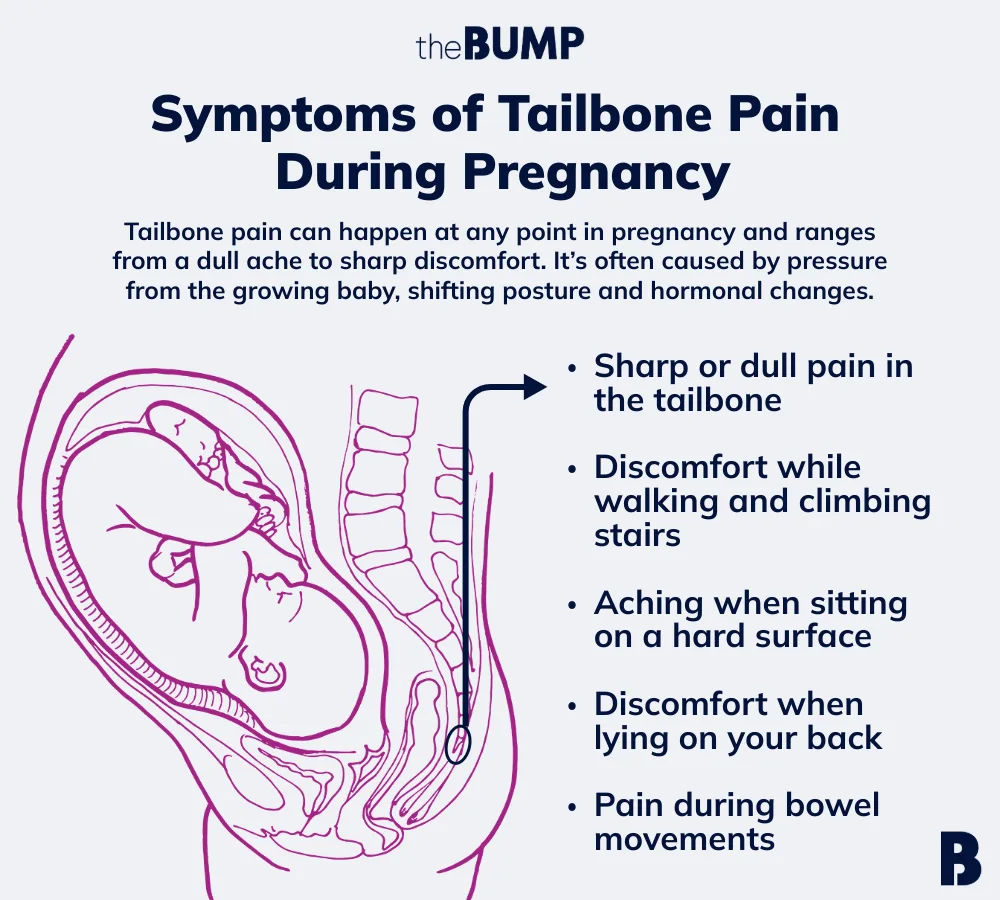
What Are the Symptoms of Coccyx Pain in Pregnancy?
The symptoms of tailbone pain in pregnancy can vary from person to person, but, according to Sherry Ross, MD, an ob-gyn, women’s sexual health expert and co-founder of Oneself Intimate Skin Care, they can include:
- Sharp or dull pain in the tailbone
- Discomfort while walking and climbing stairs
- Aching when sitting on a hard surface
- Discomfort when lying on your back
- Pain during bowel movements
How to Ease Tailbone Pain During Pregnancy
Tailbone pain can be one of the most annoying symptoms of pregnancy. But, while you can’t change the factors that cause it, there are a few things you can do to try to get relief.
- Use ice or heat on your tailbone. When the pain rears its head, reach for an ice pack or heating pad—“whichever feels better,” says Julie Lamppa, APRN, CNM, a certified nurse midwife at Mayo Clinic.
- Get a special pillow. Using a donut-shaped pillow or cushion (a round pillow with a hole in the center) can help relieve pressure when you sit, Greves says.
- Lay down on your side. If you have the choice between sitting and lying down on your side, Lamppa recommends doing the latter, since it helps take pressure off your tailbone.
- Try yoga and stretching. Doing stretching exercises through yoga can “work wonders,” Cackovic says.
- See a pelvic floor therapist. Along with yoga, Ross says pelvic floor exercises and stretches are particularly helpful if your tailbone hurts in pregnancy. These can help strengthen the muscles that support the coccyx, lower back and pelvis. “Working with a pelvic floor physical therapist can also be useful in minimizing symptoms,” she adds. She cites pelvic tilts, bridges and seated forward bends as some exercises that can help. Just be sure to continue doing any pelvic floor and lower back exercises throughout pregnancy and postpartum (as long as you’re cleared to do so).
- Take an OTC pain reliever. Tylenol, which is safe to take during pregnancy, is a good option here, Lamppa says.
- Focus on your posture: Ross notes that maintaining proper posture while sitting and standing can help ease tailbone pain, as it’ll activate other muscles in your body. A part of proper posture is wearing comfortable and flat shoes, she adds.
- Avoid certain activities and positions: While there’s not a lot you can do to stop coccyx pain in pregnancy, you can be mindful of activities that may worsen it, such as lifting heavy objects, twisting, wearing improper footwear and getting constipation, Ross says.
I had it at the end of the pregnancy and after birth. I went to a physical therapist and chiropractor and it’s all better now! Talk to your OB and get a recommendation for a physical therapist that works with women’s issues like this—they can be lifesavers!
When to Call the Doctor About Tailbone Pain
It’s always a good idea to at least mention to your doctor at your next visit when you’re having any kind of pain. But if you’re having daily tailbone pain or it’s excruciating, Shepherd recommends calling your doctor sooner rather than later. You should also notify your provider if it’s getting in the way of daily activities, like walking, sleeping, having a bowel movement or having sex. Ross notes some other symptoms to flag are ongoing constipation, if you feel you can’t empty your bladder, pelvic floor numbness and pain while using the bathroom.
Is Postpartum Tailbone Pain Normal?
There are a few different reasons you might have coccyx pain after pregnancy, but they’re almost all related to birth, Ross notes. Some reasons include:
- Having a traumatic vaginal birth
- Needing to use forceps or do a vacuum delivery
- Prolonged pushing
- Continual straining and laxity in the pelvic floor and ligaments
- A vaginal hematoma or bruising
- Complications from an episiotomy
The good news is the pain should improve after birth as the body heals, Ross says.
For those having tailbone pain…if you’re not seeing any improvement, I highly recommend seeing a pelvic floor physical therapist. This saved me from years of pain when nothing else worked.
Frequently Asked Questions
Is it common for your tailbone to hurt while pregnant?
While less frequently discussed than back pain, tailbone pain is a common complaint during pregnancy and postpartum, experts say.
How is tailbone pain in pregnancy diagnosed?
Usually, providers can diagnose coccyx pain during pregnancy just by listening to your symptoms, Ross says. They may also do a physical exam and lightly press on the tailbone area to confirm their diagnosis.
How can I stretch my coccyx when pregnant?
The key to getting rid of pain is to strengthen the muscles that support the coccyx, lower back and pelvis with exercises including pelvic tilts, bridges and seated forward bends. “Working with a physical therapist can help guide you through pelvic floor exercises to improve tailbone pain,” Ross says.
What happens if tailbone pain in pregnancy isn’t treated?
While coccyx pain isn’t a huge deal in pregnancy, it should still be communicated to your provider. If left untreated, it can affect your ability to walk, exercise, sleep, have sex and use the bathroom, Ross says, adding, “Chronic and ongoing pain can be emotionally damaging as well.”
Will tailbone pain improve after giving birth?
Tailbone pain should improve during the postpartum period as the body heals, Ross says. However, if you continue to experience persistent pain, it’s important to reach out to your provider.
How will tailbone pain affect future pregnancies?
According to Ross, even if you have coccyx pain during one pregnancy, “it’s unlikely that it will affect future pregnancies,” as long as the pain is treated. However, if it’s persistent or goes untreated, tailbone pain may affect future pregnancies.
Do you have to go to physical therapy to treat coccyx pain in pregnancy?
This really depends on how severe your tailbone pain in pregnancy is, Ross notes. You may be able to do simple stretching on your own, but for more persistent pain, a pelvic floor physical therapist can be helpful in decreasing your pain.
What do I do if my tailbone pain is severe?
If you have severe tailbone pain in pregnancy or postpartum, reach out to your provider for pain management resources. They may also refer you to a pelvic floor physical therapist.
Does tailbone pain in the third trimester mean labor is close?
“Having tailbone pain in the third trimester does not mean you are close to going into labor,” shares Ross. “You can experience pelvic pressure as you get closer to going into labor, but tailbone pain by itself does not mean labor is looming.”
Tailbone pain can be a real pain in the butt during pregnancy and postpartum, but if you’re dealing with it, know you’re not alone. “Tailbone pain during pregnancy is an underdiscussed symptom,” Ross says. “If you’re experiencing persistent tailbone pain, discussing this symptom with your healthcare provider can minimize worsening discomfort during and after pregnancy.”