

Pregnancy comes with a slew of new terms and lingo to learn. And given that you probably don’t have a background in obstetrics, it’s understandable to have questions. One medical acronym that may come up early on in your pregnancy is hCG. It stands for human chorionic gonadotropin, and it can give you—and your doctor or midwife—some insight into how your pregnancy is progressing. But what is hCG exactly, and what can your hCG levels by week mean? Here’s what you need to know.
Key Takeaways
- Human chorionic gonadotropin, also known as hCG, is a hormone that’s crucial for supporting pregnancy. It’s usually detectable around two weeks after conception via a blood or urine test
- HCG levels will double every to to three days during early pregnancy and peak between weeks 8 and 12 of pregnancy. After 12 weeks, levels will decline as the placenta and progesterone hormone takes over to support the pregnancy
- Once pregnancy is confirmed, your hCG levels by week won’t be measured, with a few circumstantial exceptions, like in the case of a suspected miscarriage.
What Is hCG?
At a basic level, human chorionic gonadotropin is a hormone that supports your pregnancy. “It’s very important in establishing and maintaining the pregnancy through helping with the placenta and development of the early embryo,” explains Christine Greves, MD, an ob-gyn at the Winnie Palmer Hospital for Women & Babies in Orlando, Florida. And, yes, it may also be what’s driving your morning sickness and causing a few other early pregnancy symptoms, according to the Mayo Clinic.
Initially, hCG is secreted to help maintain the corpus luteum—a collection of cells that make the uterus a healthy place for pregnancy, notes Julie Lamppa, APRN, CNM, a certified nurse-midwife at the Mayo Clinic. Eventually, your placenta—the organ that provides oxygen and nutrients to your growing baby—will take over progesterone production and hCG levels by week will dip (more on that below).
When Is hCG Detectable During Pregnancy?
The body starts producing the hCG hormone about 10 to 11 days after you conceive, says Kjersti Aagaard, MD, PhD, a professor of obstetrics and gynecology at Baylor College of Medicine in Houston, Texas. “Its claim to fame is that it’s the hormone that’s detected on both urine and blood pregnancy tests,” she says. When measuring hCG levels, your doctor will refer to something called beta hCG levels. In a nutshell, beta hCG levels note the exact amount of the pregnancy hormone in a person’s blood, while qualitative hCG simply measures whether or not the pregnancy hormone is present in the blood, explains Sherry Ross, MD, an ob-gyn and women’s sexual health expert.
So when is hCG detectable during pregnancy? Urine pregnancy tests can identify hCG levels when they reach 20 to 50 milli-international units/mL (mIU/mL), while blood tests are positive at 5 milli-international units/mL, Lamppa says. That typically translates to getting a positive urine pregnancy test around the time your period is due. “It usually takes about two weeks after conception for hCG to be high enough in your urine to be detected,” Greves notes. For a blood test, the hCG hormone is usually detectable 10 days after [conception].
If you’re anxiously waiting for a positive pregnancy test result, try taking a test early in the day. In general, “first morning urine is recommended because it’s when the urine is the most concentrated, and therefore lower [hCG] levels can be detected more quickly,” says Melissa Goist, MD, an ob-gyn from the Ohio State University Wexner Medical Center. If you get a negative, you can wait and try again. In a healthy pregnancy, hCG levels tend to double every 48 to 72 hours in the early days and weeks of pregnancy, according to Ross and the American Pregnancy Association (APA)
I had an at-home pregnancy test and was scheduled for an ultrasound at 7 weeks. I had typical pregnancy labs at that appointment—no hCG levels were drawn because I hadn’t had any concerning symptoms, and there was a clear intrauterine pregnancy with a strong heartbeat.
Normal Levels of hCG by Week of Pregnancy
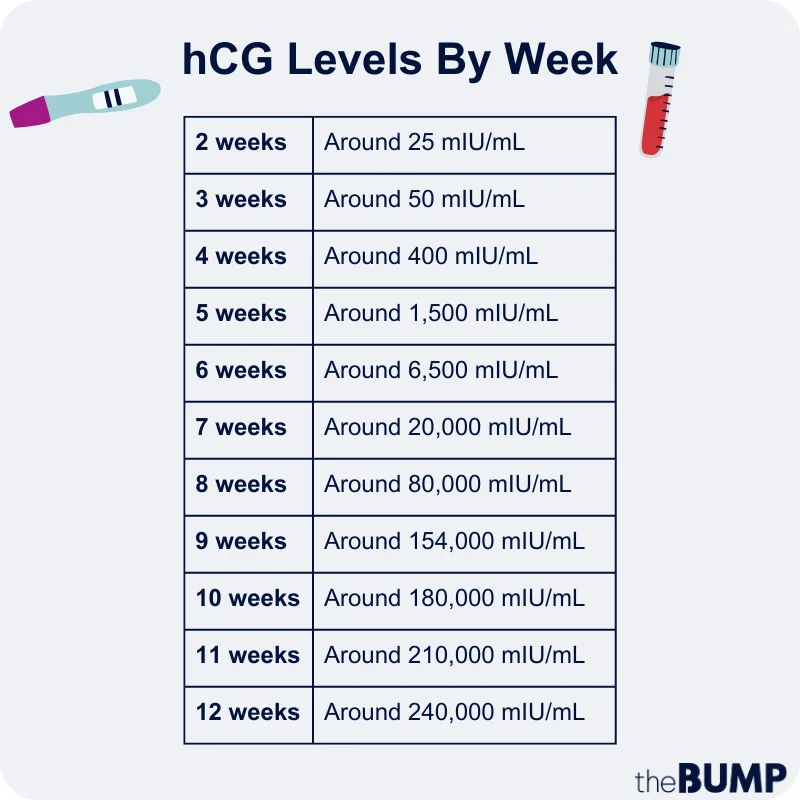
It’s important to know that levels of hCG typically only increase until a certain point in your pregnancy. According to experts, hCG will peak sometime between weeks 8 and 12, before starting to decrease. But why do hCG levels begin to fall during this time? It’s because your placenta has developed enough to take over and can start supplying progesterone to your pregnancy to help it progress, Lamppa explains.
hCG Levels By Week Chart
Standard hCG levels charts show what hCG levels by week can look like during the first trimester. Of course, take this information with a grain of salt. “Clinically speaking, as providers, we don’t even look at these [charts], nor depend upon them,” Lamppa says, noting that hCG levels in pregnancy are just too subjective.
Normal hCG levels by week for twins
In a twin, triplet or other multiples pregnancy, hCG levels by week will typically be higher than they are for a singleton pregnancy, Ross says. However, since hCG ranges for pregnant people vary so much, it can be difficult to pinpoint what’s considered “normal.”
Calculating hCG Levels: Why Do Doctors Do It?
Once a pregnancy test turns positive, there’s usually no reason to assess beta hCG level. “The overwhelming majority of pregnancies will never have a reason to check this,” says Aagaard. There are a few specific scenarios where your beta hCG levels might need to be checked, though. “These include situations where we’re trying to decipher whether a very early pregnancy is developing normally in the uterus, or if there’s a risk of an inevitable miscarriage,” Aagaard says. “To decipher this, we have to measure the beta hCG twice, two to three days apart.” Basically, the first level gives your doctor a baseline, while the second helps them determine if hCG is rising as expected or declining prematurely. The latter could indicate a potential pregnancy loss.
Lamppa adds that if there’s the suspicion of an ectopic pregnancy (when implantation occurs outside of the uterus), measuring hCG level can be revealing. Of course, a hCG blood test alone isn’t diagnostic, and an ultrasound is necessary to confirm, per Cleveland Clinic.
Another scenario that might warrant more thorough testing of your hCG levels in pregnancy? If you’ve conceived through in-vitro fertilization (IVF), your doctor might monitor your levels more closely, says Lamppa.
Symptoms of Rising hCG Levels
The hCG hormone may be to blame for your morning sickness and other early pregnancy signs. Ross notes some symptoms of rising hCG levels by week include:
- Nausea and vomiting
- Fatigue
- Breast tenderness
- Dizziness
- Food cravings
- Intestinal changes
- Increased urinary frequency
My doctor was concerned about how high my hCG levels were, so she wanted to do one more draw. She advised me that if it only increased a little, she wouldn’t be too concerned. But they almost doubled! I’m worried this is a molar or ectopic pregnancy.
What Do High hCG Levels Mean?
According to Greves, if you’re pregnant with twins or multiples, your hCG levels by week may be higher than if you were having a singleton. (But a high hCG level doesn’t automatically mean you’re expecting more than one baby—again, levels of hCG can vary by person and pregnancy.) In fact, Lamppa says high hCG levels can be normal with a singleton pregnancy or a multifetal one. They can also happen with an ectopic or molar pregnancy, which are nonviable. In certain cases, high hCG levels can also suggest certain types of cancers, Ross notes.
What Do Lower hCG Levels Mean?
It’s true that early on, declining hCG levels by week could mean a pregnancy isn’t developing properly or suggest an ectopic pregnancy or loss. On the flip side, lower levels could also suggest “an early healthy pregnancy,” Ross notes. It could be “[normal] based on how far the pregnancy has advanced,” Lamppa adds.
Suffice it to say, don’t panic if you learn your hCG levels are on the low side—it might not mean anything, Aagaard says. She adds that, for this reason, doctors and midwives don’t typically check beta hCG levels unless it’s deemed necessary. “It most commonly leads to more testing and increased anxiety,” she adds.
There were concerns about my HCG in my early pregnancy and now I have an amazing almost 3-year-old!
Can You Do Anything to Increase hCG Levels?
It’s natural to want to do everything you can do to maintain a healthy pregnancy, and it’s scary knowing that declining hCG in early pregnancy might mean an impending miscarriage. Unfortunately, since the hormone is produced and controlled by the body, there’s really nothing you can do to raise (or lower) your hCG levels during pregnancy, Ross says. This is one of those things you simply can’t control.
Frequently Asked Questions
What hCG level indicates pregnancy?
According to Ross, “HCG levels above 25 milli-international units/mL indicate pregnancy.” Monitoring these levels along with performing an ultrasound can help confirm a healthy pregnancy.
What hCG level indicates miscarriage?
Experts don’t point to a certain hCG level to indicate miscarriage. Instead, Ross notes that hCG levels that are low—or even rising irregularly—may suggest a possible miscarriage, especially when accompanied by other symptoms like vaginal bleeding and cramping.
What is a normal hCG level when not pregnant?
Again, this measurement will vary from person to person. But for people who aren’t pregnant, normal hCG levels are generally below 5 mIU/mL, Ross says.
Will hCG levels be higher depending on baby’s sex?
According to Ross, baby’s biological sex has no effect on hCG levels in pregnancy.
At what hCG level can you see baby’s heartbeat?
“The hCG level to first see a baby’s heartbeat on a transvaginal ultrasound is around 10,000 m IU/ml,” Ross notes.
Can stress affect hCG levels during pregnancy?
While hCG levels in pregnancy aren’t affected by maternal stress, they are affected by other lifestyle factors, such as dehydration and drug use, Ross notes. “Levels can also be present for those taking other antidepressants, antipsychotics and medical conditions affecting the liver, kidneys, bowels, stomach, pancreas, lungs and skin,” she adds.
To Sum it Up
Determining whether your hCG levels by week are normal can be confusing, especially since there isn’t a medically accepted standard. Basically, if your provider isn’t concerned with this, you should be either! Of course, don’t hesitate to ask any and all questions, especially if they are keeping tabs on your levels of hCG. Otherwise, experts say it’s not something you need to think twice about.